
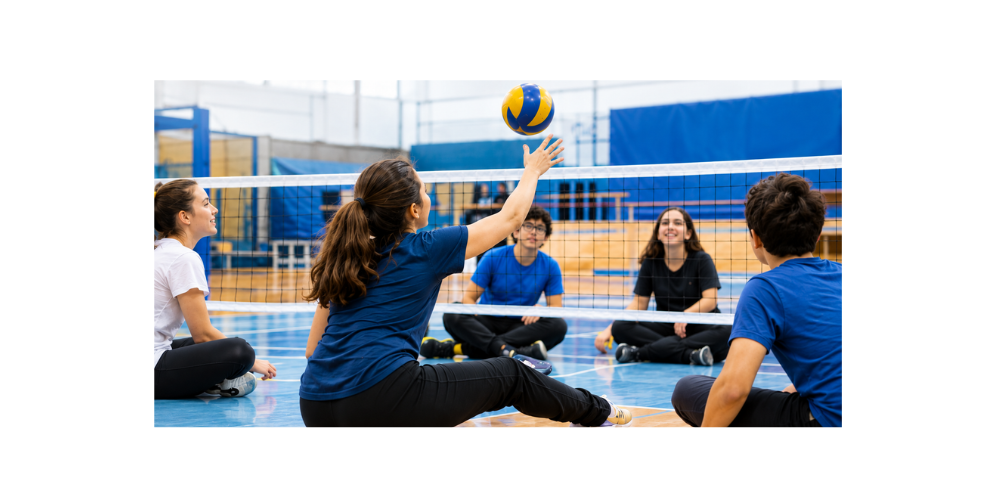
How European collaboration turns shared knowledge into practical,
court-ready tools for inclusive Sitting Volleyball. 🏐
Promoting social inclusion through sport is a challenge that is not won on paper, but on the court, in local sports halls, and during everyday training sessions. When introducing Sitting Volleyball to mixed-ability groups, coaches and educators face a fundamental question:
How do you turn co-design into something coaches can actually use on the court?
Within the European initiative INSPIREVolleyball (co-funded by the Erasmus+ Sport program of the European Union), this challenge is being met head-on. The project brings together sports clubs, inclusion experts, and educational institutions across Europe—including KEAN (Greece, coordinator), USMA Padova (Italy), AEK (Greece), OPA (Bulgaria), Sports Ambassadors Association / Kapsayıcı Spor Kulübü (Turkey), and CERC (Slovenia).
At the heart of this collaboration is the creation of an innovative Training Toolkit designed to turn inclusive values into actionable practice.
Co-Design: beyond Collecting Ideas
Effective co-design does not end with collecting ideas. It turns shared knowledge into tools that can be used, tested, and brought onto the court.
Within INSPIREVolleyball, the development of training materials starts from the needs and practical challenges identified across partner countries. By combining scientific insights with real-world coaching experience, the project transforms shared expertise into a clear, accessible, and adaptable training pathway.
The result is a toolkit designed specifically for real training environments: practical activities, coaching guidance, inclusive strategies, and adaptable exercises that empower coaches to introduce sitting volleyball to participants with diverse abilities.
The toolkit pathway: A progressive learning model
The pedagogical approach outlined in the toolkit moves progressively to ensure that players of all skill levels can build confidence and competence:
- Seated movement & ball familiarisation: focuses on gaining floor mobility, balance, seated positioning, and developing ball control from a lowered perspective.
- Cooperation: pair and group exercises designed to foster trust, active
communication, and mutual support on the court. - Tactical Understanding: helps players read the game, adjust positioning, and apply inclusive tactics where every participant contributes actively to the point.
- Match Play: brings all concepts together into game situations, combining learning, active participation, and inclusive competition.
On the court: first-hand Testimonial from the Field
A training toolkit is only as good as its impact in the gym. As pilot testing gets underway across Europe, feedback from real sessions is proving the pedagogical and human value of this approach.
A compelling report comes from Ahmet DALCI (Project Coordinator, Physical Education Teacher, and Coach at Sports Ambassadors Association / Kapsayıcı Spor Kulübü and İnönü Üniversitesi Hayriye Başdemir Secondary School in Turkey), who documented the first sitting volleyball session with young participants:
Field test report – Ahmet DALCI:
“The first sitting volleyball session was a fun, different, and educational experience for the children. They approached the exercises with curiosity and enthusiasm. At the beginning, some of them needed a little time to adapt to moving while seated, controlling the ball, and passing, but they quickly became more confident and actively participated in the activities.
The children particularly enjoyed the pair and team exercises. Supporting each other, communicating, and playing together helped strengthen their teamwork. Experiencing sitting volleyball also helped them better understand different ways of participating in sport and contributed to developing their awareness of inclusion and empathy.”